The Food Pyramid – Design, Nourishment, and Biological Order
Published 01/12/2026
Table of Contents
- Introduction
- The Purpose and Power of the Food Pyramid
- The Old Food Pyramid: Origins, Intentions, and Structural Flaws
- When the Food Pyramid Was Created and Who Created It
- The Food Pyramid Scam: Policy, Industry, and Disconnection from Nature
- The New Food Pyramid and RFK Jr.: A Needed Course Correction
- Comparing the Old Food Pyramid and the New Food Pyramid
- What God-Designed Biology Teaches Us About Food
- The Mediterranean Diet Food Pyramid in Context
- What the Food Pyramid Would Look Like If It Respected Our Biology
- Traditional African Perspective
- Modern Research
- Closing Reflection
- Sources
Introduction
For generations, the food pyramid has quietly shaped how people eat, think, and judge what is considered "healthy." Displayed in classrooms, clinics, and government materials, it has functioned as an unquestioned authority rather than a conversation. From the Ancient African Secrets perspective, this model is not merely a nutrition guide, but a reflection of how far modern society has drifted from God-designed biology, natural order, and ancestral wisdom.
Food is not simply fuel. It is information. It communicates with the body, influences blood, organs, and mind, and either supports balance or contributes to disorder. This article serves as cornerstone guidance for understanding nutrition through a systems-based, African-rooted, and biologically respectful lens — one that honors design, context, and lived reality rather than charts alone.
The Purpose and Power of the Food Pyramid
The food pyramid was designed as a visual shortcut — a simplified way to communicate how people should eat. Its power lies not in its accuracy, but in its authority. Once published and endorsed, it became doctrine, taught repeatedly until it felt permanent and unquestionable. Over time, this single graphic shaped the current food pyramid mindset for entire generations.
Food, however, is not abstract. It is living substance, created with intention to sustain a living body. When dietary guidance ignores this reality and reduces nourishment to categories and servings, imbalance is inevitable. A diagram cannot replace biological feedback, lived experience, or ancestral memory.
The Old Food Pyramid: Origins, Intentions, and Structural Flaws
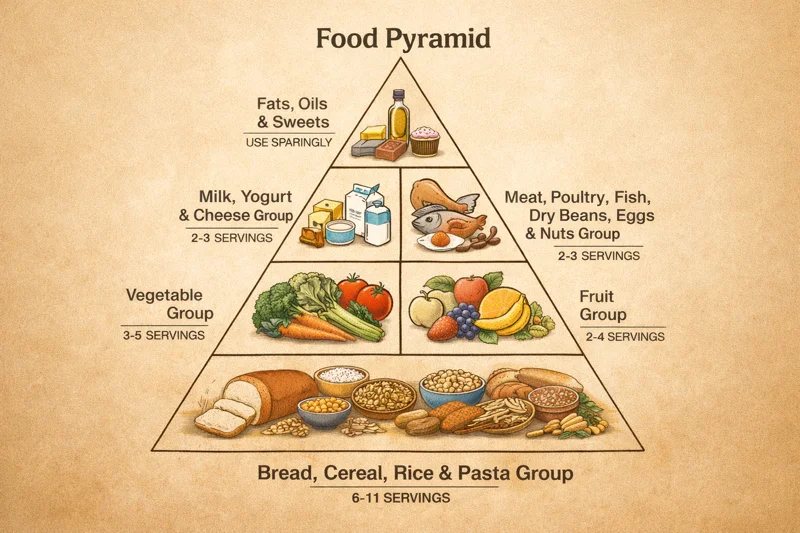
The old food pyramid placed grains at the foundation, encouraging six to eleven servings per day. Bread, cereal, rice, and pasta were framed as dietary necessities rather than optional energy sources. Fats were pushed to the top, portrayed as something to fear or avoid, while natural proteins were compressed into narrow tiers.
This structure suggested that refined carbohydrates should form the bulk of daily nourishment. It also implied that all calories were interchangeable, regardless of how they interacted with blood sugar, hormones, digestion, or inflammation. The model ignored food quality, preparation methods, and biological individuality.
When the Food Pyramid Was Created and Who Created It
The food pyramid was officially introduced in 1992 by the United States Department of Agriculture. While presented as science-based, its development was shaped heavily by agricultural economics, surplus grain production, and policy compromise.
Understanding when the food pyramid was created and who created the food pyramid matters because it explains why the model emphasized what was plentiful, not necessarily what was biologically optimal. Guidance was shaped from the top down, rather than from the body outward.
The Food Pyramid Scam: Policy, Industry, and Disconnection from Nature
The phrase "food pyramid scam" does not imply conspiracy so much as misplaced priority. The model aligned conveniently with industrial food systems, subsidized crops, and mass production. Under its guidance, highly processed foods were elevated under the banner of "whole grains," while traditional fats, organs, and animal foods were discouraged.
This separation from nature had consequences. People were encouraged to eat foods that resembled nourishment but lacked vitality, leading to cycles of hunger, cravings, and imbalance. The body was expected to adapt to the chart, rather than the chart adapting to the body.
The New Food Pyramid and RFK Jr.: A Needed Course Correction
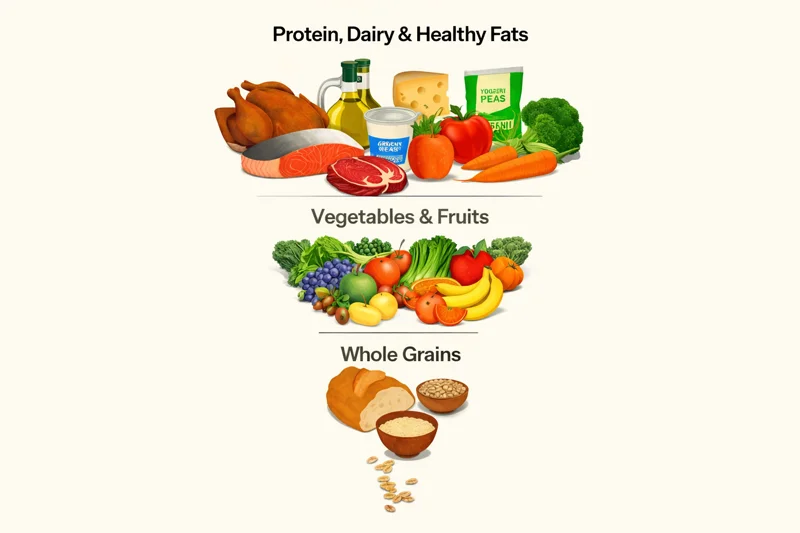
The new food pyramid promoted under RFK Jr. represents a meaningful course correction. It challenges decades of carbohydrate dominance and places emphasis back on whole foods, protein quality, and metabolic stability.
Rather than anchoring the diet in grains, this model prioritizes nutrient-dense foods the body recognizes easily: vegetables, fruits, proteins, and healthy fats. It acknowledges that ultra-processed foods disrupt biological signaling and should not form the foundation of daily eating.
Comparing the Old Food Pyramid and the New Food Pyramid
The old food pyramid prioritized quantity over quality, policy over physiology, and convenience over nourishment. The new food pyramid shifts the focus toward food integrity, biological response, and long-term resilience.
Where the old model promoted constant grain consumption, the new approach reduces grains to a supporting role. Vegetables, natural fats, and clean proteins are emphasized because they stabilize blood sugar, support hormones, and provide the raw materials the body needs for repair and renewal.
What God-Designed Biology Teaches Us About Food
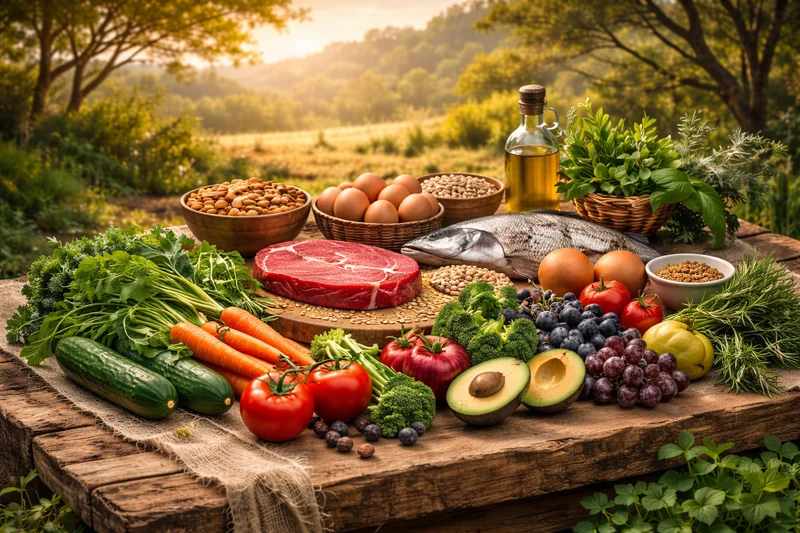
The human body is not accidental. It was designed with precision and purpose. Digestion depends on enzymes activated by real food. Blood sugar balance depends on fiber, fats, and protein working together. Hormonal health depends on minerals and cholesterol-based compounds. Immune strength depends on micronutrients found in whole, living foods.
When dietary guidance aligns with this design, the body functions with efficiency and clarity. When it contradicts it, the body compensates — often at great cost over time.
The Mediterranean Diet Food Pyramid in Context
The Mediterranean diet food pyramid offers a culturally specific example of alignment. Emphasizing vegetables, olive oil, fish, legumes, and shared meals, it reflects moderation, rhythm, and relationship with food. While not universal, it demonstrates principles that echo ancestral nourishment more closely than the old food pyramid.
What the Food Pyramid Would Look Like If It Respected Our Biology
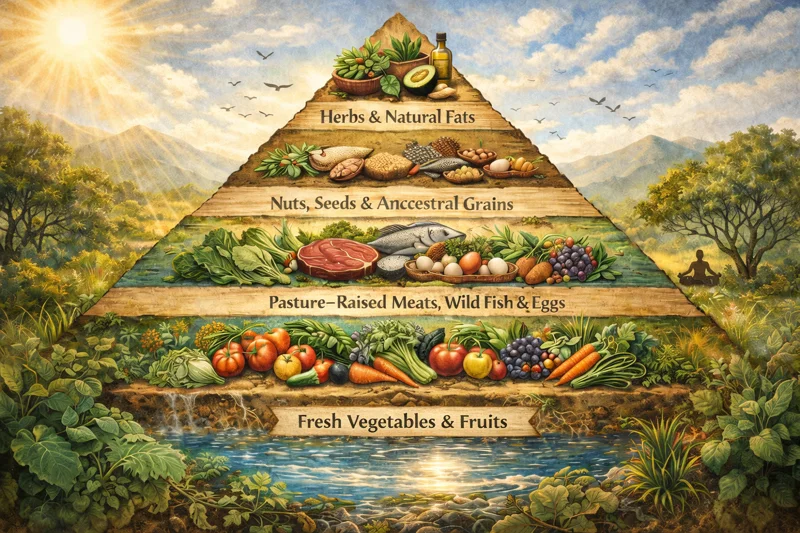
If the food pyramid respected our biology, it would not be rigid or grain-based. Its foundation would consist of whole, water-rich vegetables and fruits that support digestion, hydration, detoxification, and mineral balance. These foods would dominate not by serving count, but by daily presence.
Natural fats would no longer be feared. They would be recognized as essential for cellular membranes, hormone production, and nervous system function. Clean proteins would be included for tissue repair and renewal, not excess. Refined carbohydrates would occupy a minimal space, understood as optional rather than foundational.
Surrounding this pyramid would be elements no chart can capture: clean water, sunlight, fresh air, movement, rest, and connection to natural soil. Nutrition would be understood as one part of a larger living system.
Traditional African Perspective
In African traditions, food is inseparable from life force. Meals are chosen for balance, blood quality, digestion, and longevity. Roots, greens, seeds, and animal foods are respected for their systemic effects, not isolated nutrients. Health is maintained through rhythm, season, and relationship.
Traditional foodways treat nourishment as a pattern embedded in community, land, and ancestral memory. The body is understood as designed with intention, and food is honored as information that communicates directly with organs, blood, and spirit.
Modern Research
Modern research increasingly supports whole-food dietary patterns. Diets high in ultra-processed foods are associated with metabolic disruption, while diets rich in vegetables, natural fats, and quality proteins are associated with resilience and long-term stability.
Scientific studies on dietary patterns consistently show that food quality, preparation methods, and biological context matter more than isolated nutrient counts. Modern science is slowly confirming what ancestral systems preserved through observation and experience.
Closing Reflection
The conversation around the food pyramid is not about rejection, but remembrance. When guidance aligns with God-designed biology and ancestral wisdom, nourishment becomes simple again. The body does not respond to diagrams — it responds to truth, consistency, and care.
Sources
- United States Department of Agriculture. Dietary Guidelines for Americans
https://www.dietaryguidelines.gov - Harvard T.H. Chan School of Public Health. Healthy Eating Plate & Pyramid
https://www.hsph.harvard.edu/nutritionsource - World Health Organization. Healthy Diet Fact Sheet
https://www.who.int/news-room/fact-sheets/detail/healthy-diet - Monteiro CA et al. Ultra-processed foods and health outcomes
https://www.ncbi.nlm.nih.gov/pmc/articles/PMC6389637/ - Ancient African Secrets To Great Health – PeterJohn Fox
Continue exploring
Get the 15-Day Detox Cleanse Planner FREE
Join the newsletter for practical routines and updates.
We respect your privacy. Unsubscribe anytime. No spam, ever.